
Press Release: The International Ozone Commission, on the 38th anniversary of the Montreal Protocol, underscores the success of the protocol, and stresses the value of continued observations, modeling, and research.

The 38th International Day for the Preservation of the Ozone Layer, September 16, 2025, marks the anniversary of the signing of the 1987 Montreal Protocol on Substances that Deplete the Ozone Layer. This protocol, a treaty signed by every country in the world and hailed as among the most successful international agreements to date, controls the production and use of ozone depleting substances (ODSs) such as chlorofluorocarbons (CFCs) and the other substances used as initial CFC replacements. As a result of the actions taken worldwide in response to the protocol and its amendments and adjustments, atmospheric abundances of ODSs are declining, and the stratospheric ozone layer, which shields life on Earth from harmful solar ultraviolet radiation, is showing clear signs of recovery.

The theme of the 2025 International Day for the Preservation of the Ozone layer, “From science to global action”, acknowledges the success of the protocol, an accomplishment whose success was critically dependent on sustained long-term cooperation between scientists, industry, and governments. 

This year also marks the 40th anniversary of the adoption of the Vienna Convention for the Protection of the Ozone Layer, in which countries agreed to undertake cooperative scientific studies of the processes affecting the ozone layer and to regularly report on its health. Furthermore, it is also 40 years since the publication in 1985 of the landmark paper by Farman, Gardiner, and Shanklin that reported a steep decline in the amount of ozone above Antarctica during springtime, starting in the mid-1970s. Crucially, there were no then-known processes that could account for the existence of this “ozone hole”. These observations spurred many research efforts in the subsequent years, including measurement campaigns, laboratory studies, and modeling activities, all aimed at identifying the processes involved. 

The 1985 discovery of the ozone hole underscores the ability of the atmosphere (and the Earth system more broadly) to “surprise” the scientific community. It serves as a reminder of the importance of long-term observations of key Earth system parameters, using a robust, accurate, and well-understood measurement system based on complementary observations sampling the atmosphere directly from balloons and aircraft and remotely both from the ground and space. Continuation of such measurements, and of associated laboratory studies and modeling efforts needed to robustly explain observed ozone changes, is essential for avoiding further surprises and for ensuring that trajectories which endanger the well-being of human society and life on Earth are avoided.

This reminder is particularly timely given the potential loss of funding for long-established observing systems (spaceborne, ground-based, and balloon-borne) and science research that are essential for tracking ozone layer recovery. The International Ozone Commission (io3c.org) urges governments worldwide to continue the essential work of monitoring, diagnosing, and verifying ozone layer recovery.

For more information contact: Dr. Corinne Vigouroux, Secretary of the International Ozone Commission, Royal Belgian Institute for Space Aeronomy (BIRA-IASB), Ringlaan 3, 1180 Uccle, Belgium, corinne.Vigouroux[at]aeronomie.be.


See the whole statement (see also translation in Spanish, French and Chinese)
Press Release: The International Ozone Commission, on the 37th anniversary of the Montreal Protocol, reports successes, developments, and future challenges in monitoring ozone layer recovery

September 16th is the International Day for the Preservation of the Ozone Layer, celebrating the signing anniversary of the 1987 Montreal Protocol on Substances that Deplete the Ozone Layer. The Montreal Protocol is the treaty, ratified by every country in the world, that controls the production and use of ozone depleting substances (ODSs) such as chlorofluorocarbons (CFCs) and their early replacements. As a result of the Protocol, ODSs are declining and the ozone layer, including the Antarctic ozone hole, is showing signs of recovery, ensuring continued protection of life on Earth from harmful solar ultraviolet radiation. Nevertheless, the future evolution of surface solar ultraviolet radiation has important uncertainties caused by the expected changes in our climate.

The theme of the 2024 International Day for the Preservation of the Ozone Layer is “Montreal Protocol: Advancing Climate Action”. This theme acknowledges the Protocol’s accomplishments beyond its central focus of putting the world on the road to repairing the ozone layer. Specifically, as ODSs are also potent greenhouse gases, their decline has also contributed to a reduction in the warming of the climate. It is estimated that the Protocol has postponed the expected date of an ice-free Arctic by up to 15 years. The 2016 Kigali Amendment to the Protocol, ratified by 80% of the original Protocol signatories, phases down production of the ozone-safe hydrofluorocarbons (HFCs) in light of their global warming potential, in favor of newer compounds that have a smaller climate footprint.

Among the numerous and diverse studies on the ozone layer and the processes affecting it carried out over the past year, many have provided reassurances that the core factors affecting ozone layer stability are generally well understood and that ozone recovery is continuing in line with expectations. The January 2022 eruption of the undersea Hunga volcano, which injected an unprecedented amount of water vapor into the stratosphere, has provided a unique opportunity to test our understanding of the processes affecting stratospheric ozone, as embodied in state-of-the-art atmospheric models. Although both the aerosol particles and water vapor from the eruption have temporarily changed stratospheric dynamics and chemistry, the observations have broadly been in line with expectations from models. The plume did not reach the southern polar regions early enough to impact the 2022 Antarctic ozone hole, where chlorine from ODSs rapidly destroy ozone every spring. In contrast, the 2023 Antarctic winter started with record levels of stratospheric water vapor at high southern latitudes, resulting in unprecedented early conversion of chlorine to ozone-destroying forms in May-June. However, the amount of chlorine converted was much smaller than is typically seen in August-September, when sunlight returns to polar latitudes and ozone destruction is strongest. Therefore, the excess water vapor from the Hunga eruption had little overall impact on the 2023 Antarctic ozone hole.

Notwithstanding the accomplishments of the Montreal Protocol to date, other studies published over the last year have highlighted the need for further research into potential new threats to the ozone layer. For instance, one study showed that recent measurements of the composition of stratospheric aerosols includes a notable concentration of aluminium and other elements, attributed to the increasing number of re-entering spacecraft breaking apart in the upper atmosphere. The study noted that the amount of metals deposited in the atmosphere by re-entering spacecraft is expected to approach that from meteors in future, given the rapidly increasing number of small-satellite launches planned in the coming years. This work highlights a need for clearer understanding of the potential of such metal-containing aerosols to affect ozone abundances.

The 2024 Quadrennial Ozone Symposium (QOS) was hosted by scientists from the United States of America and held in a hybrid in-person/remote format from July 15–19 in Boulder, Colorado. The participation of more than 220 scientists, 180 of whom attended in person, highlights the continued strong interest of the scientific community in research related to ozone in the stratosphere and troposphere, the processes driving changes in ozone abundances, and the impacts of those changes.

A recurring topic in the Symposium was the anticipated cessation of spaceborne vertically resolved measurements of gases other than ozone that are needed to distinguish chemical and dynamical influences on ozone distribution. Following the anticipated 2026 termination of NASA’s Aura mission (launched in 2004) with its cornerstone Microwave Limb Sounder (MLS) instrument, and the eventual demise of the Canadian ACE-FTS instrument (launched in 2003), there will no longer be any stratospheric measurements of long-lived trace gases (which characterize changes in atmospheric circulation) or of many of the reactive gases that are involved in ozone chemistry. This will increase reliance on limited ground-based, airborne, and balloon-borne observations of these species, and raise the importance of continued funding for such measurements in an era of declining research budgets.

The International Ozone Commission notes with concern an ongoing decline in both budgets for ozone-related research and the number of scientists engaged in such studies. Despite the tremendous progress made in understanding the processes affecting atmospheric ozone over the last few decades, the atmosphere has not lost its ability to surprise. Continual vigilance, in the form of both sustained measurements and state-of-art models and laboratory studies, is essential for ensuring that stratospheric ozone continues to evolve as expected in response to the Montreal Protocol and changing climate.

For more information contact: Dr. Corinne Vigouroux, Secretary of the International Ozone Commission, Royal Belgian Institute for Space Aeronomy (BIRA-IASB), Ringlaan 3, 1180 Uccle, Belgium, corinne.Vigouroux[at]aeronomie.be.


See the whole statement

The Quadrennial Ozone Symosium 2024 was held successfully in Boulder, USA, on July 14 – 19, 2024

See QOS 2024 website: https://qos2024.colorado.edu/

The 2024 Dobson Award and the 2024 Joseph C. Farman Award were given at the QOS2024

The 2024 Dobson Award and the 2024 Joseph C. Farman Award were given at the QOS2024.

The « Dobson Award for Young Scientists » is granted for one or more outstanding research paper(s) in atmospheric sciences published or accepted in a refereed journal since the last Quadrennial Ozone Symposium (2016) by a young scientist (within 10 years of Ph.D).

The 2024 Dobson award winner is Luke Western

The « Joseph C. Farman Award » is granted to one or more outstanding scientists who have created and used high-quality, long-term time series of atmospheric measurements related to the study of atmospheric ozone and/or surface ultraviolet radiation.

The 2024 Farman award winners are Herman Smit and Philippe Nédelec

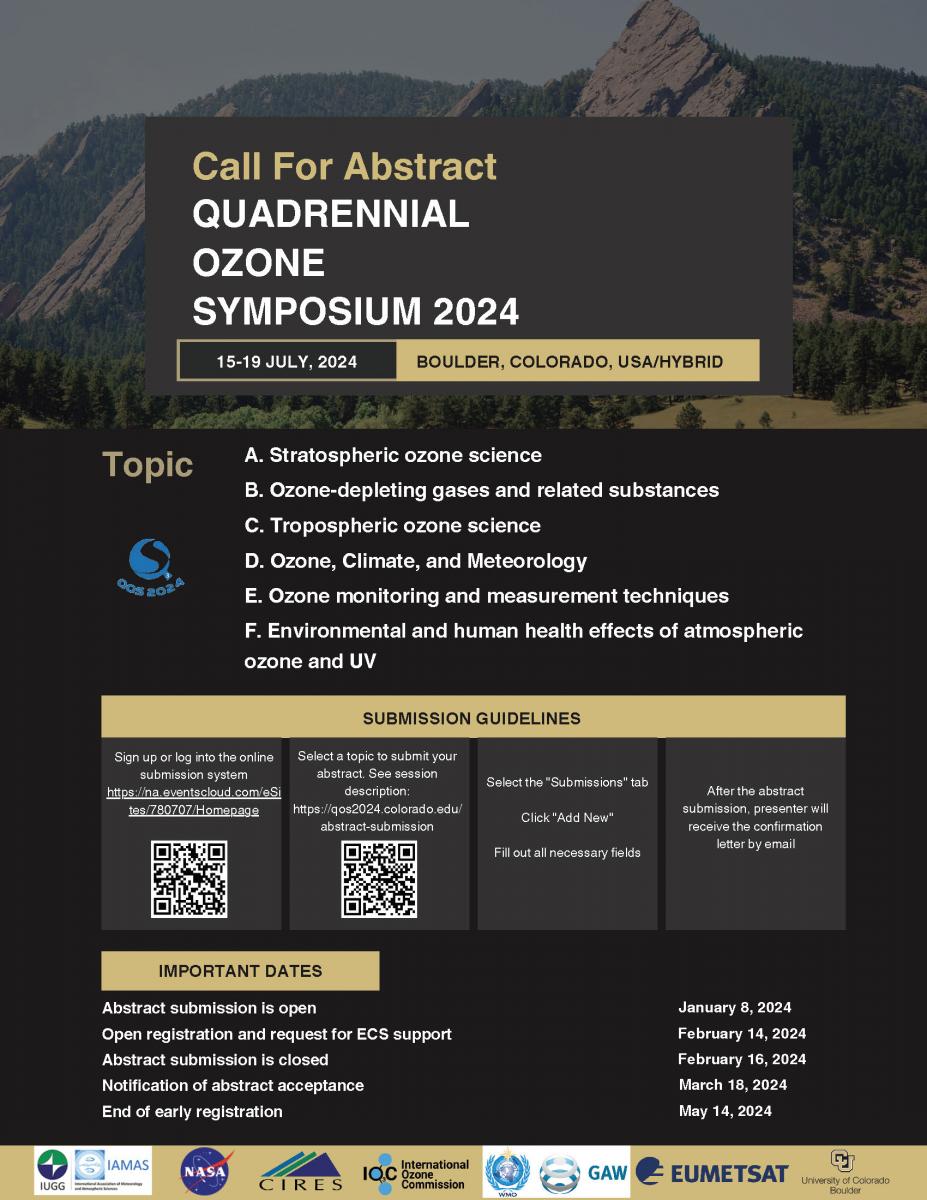
QOS 2024: Call for Abstracts Open Up to March 1st, 2024

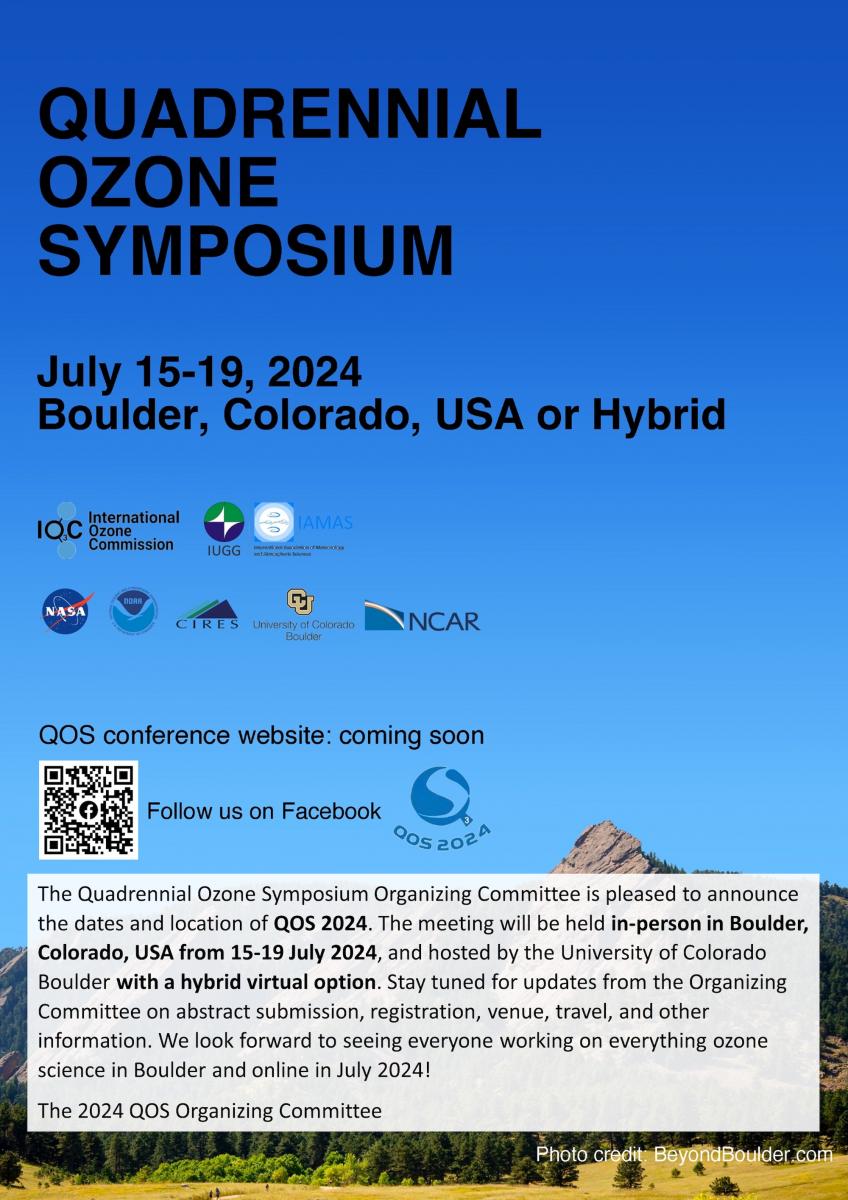
The Quadrennial Ozone Symposium Organizing Committee is pleased to announce that QOS 2024 will take place from 15–19 July 2024 in Boulder, Colorado, hosted by the University of Colorado Boulder with a hybrid virtual option.

Topic

  1. Stratospheric ozone science
  2. Ozone-depleting gases and related substances
  3. Tropospheric ozone science
  4. Ozone, Climate, and Meteorology
  5. Ozone monitoring and measurement techniques
  6. Environmental and human health effects of atmospheric ozone and UV


Abstract submission timeline

  • Submission Opens: January 8, 2024
  • Submission Closes: March 1st, 2024
  • Acceptance Notifications: March 31st, 2024


Submission guidelines: https://na.eventscloud.com/eSites/780707/Homepage

The official website of the Quadrennial Ozone Symposium 2024: https://qos2024.colorado.edu/


Press Release: The International Ozone Commission, on the 36th anniversary of the Montreal Protocol, reports successes and new milestones for progressing toward ozone layer recovery

September 16th is the International Day for the Preservation of the Ozone Layer, celebrating the anniversary of the 1987 signing of the Montreal Protocol on Substances that Deplete the Ozone Layer.

The Montreal Protocol is the globally ratified treaty that controls the production and consumption of ozone depleting substances (ODSs) and many replacements for these substances.

The theme of the International Day for the Preservation of the Ozone Layer is: “Montreal Protocol: fixing the ozone layer and mitigating climate change ». It highlights the projected impact of the Protocol on climate change through its Kigali Amendment in phasing down HFCs – potent greenhouse gasses – and the adoption of green cooling technologies. Since 1985, the international ozone and climate communities have strongly collaborated under the Vienna Convention for the Protection of the Ozone Layer. The Convention mandates a worldwide ozone research effort to evaluate and measure the Earth’s critically important ozone layer.

The Antarctic ozone hole has reappeared in 2023. The ozone hole is caused by the still high levels of the human-produced and long-lived ODS in our atmosphere. The ozone hole has occurred every year since the early 1980s. The ozone hole severity stopped increasing in the 1990-2010 period and has shown a slight improvement over the last decade, consistent with theory and model simulations with the declining ODS levels.

Atmospheric ODS concentrations are decreasing, but are still at the levels that can cause significant polar spring-time ozone destruction. Thanks to the Montreal Protocol, this ODS decrease is causing the Antarctic ozone hole and ozone depletion at global scale to slowly decrease. The ozone hole is projected to return to 1980 levels in the 2060-2070 period.

The January 2022 Hunga Tonga-Hunga Ha’apai (HTHH) eruption injected an unprecedented amount of water vapour into the stratosphere, on top of volcanic aerosols. This water vapor plume was carried into the Antarctic vortex in early spring 2023 (as seen by the NASA Aura satellite’s Microwave Limb Sounder), and this may have an impact on the 2023 ozone hole. The HTHH volcanic eruption illustrates that the ozone hole’s year-to-year variability can be enhanced by unexpected events. Large variability of Antarctic and Arctic ozone depletion in recent years demonstrates the need for continuous monitoring of the ozone layer and ozone depleting substances (ODS) to assess global compliance to the Montreal Protocol.

Arctic ozone depletion is generally much weaker than its Antarctic counterpart, and it was again moderate in the spring of 2023. Arctic depletion is typically caused by a combination of factors that require strong polar vortices especially through the March period accompanied by unusually weak dynamical processes over the winter period. Typically, these processes drive movements of ozone-rich air through the polar vortex.

Our ability to monitor and understand ozone and the stratosphere is crucially dependent on satellite, balloon, and ground-based ozone observing systems. The coming demise of long-term satellites (e.g., NASA’s Aura, Aqua, and Terra) will limit scientific monitoring of both ozone layer health and levels of anthropogenically produced ODSs. As noted above, the HTHH eruption is having a significant impact on climate, ozone, and the stratosphere. Without continuous global monitoring, it would be difficult to monitor and understand this event. The recent findings of unexpected CFC-11 emissions further remind the science community of the Vienna Convention’s Article 3 that requests “systematic observation of the state of the ozone layer and other relevant parameters. ” Similarly, the associated path to recovery for the UV-B exposure levels has additional uncertainties from changes in cloudiness and aerosols related to manmade climate change. This is why it is recommended that the usual precautionary measures to protect from excess exposure of humans to solar UV-B radiation should continue to apply in the decades to come.

The Montreal Protocol is a binding, pioneering agreement that solved a global atmospheric pollution problem. The science challenges of ozone depletion have led to a substantial increase of our understanding since the signing of the Montreal Protocol, and this increase has enabled policies that control ODS consumption and production. The Protocol provides a successful blueprint for development of global science-policy dialogue on environmental issues.

After a fully remote QOS in 2021 due to Covid restrictions, the next 2024 Quadrennial Ozone Symposium will be held in Boulder, USA on 15-19 July 2024.

This text was last reviewed by the IO3C members on September 14th 2023

For more information: Dr. Irina Petropavlovskikh, Secretary of the International Ozone Commission, CIRES/NOAA, 325 Broadway R/GMD, Boulder, CO, 80305-3328, phone: +1-303-497-6279, fax :+1-303-497-5590, irina.petro@noaa.gov


See the whole statement

The next Quadrennial Ozone Symposium will take place in Boulder, Colorado, USA on July 15-19, 2024

WMO recruits a scientific officer in charge of WMO work on the implementation of the Montreal Protocol on Substances that Deplete the Ozone Layer and its Vienna Convention

DEADLINE FOR APPLICATION: 10 April 2023

ORGANIZATIONAL UNIT

Atmospheric Environment and Research (AER) Division
Science and Innovation Department

DUTIES AND RESPONSIBILITIES

Under the supervision of the Director Science and Innovation (SI) Department, the incumbent will perform the following duties:

(a) Keep informed of research developments in, and new requirements for the observations and modelling of the chemical composition and physical characteristics of the atmosphere, especially those related to stratospheric ozone and atmospheric radiation;

(b) Lead WMO work on the implementation of the Montreal Protocol on Substances that Deplete the Ozone Layer and its Vienna Convention in close relation with other international organizations, experts and partners, participation and contribution to discussions relevant to science and research, coordination of monitoring activities, quality control, data management, modelling and capacity development initiatives and projects, representation of WMO at meeting of Parties of MoP/VC and support linkages of this topic with climate change and other connected societal problems related to atmospheric composition;

(c) Support implementation of the research, observations, modelling, training and communication related to total ozone and ultraviolet (UV) radiation, etc. working closely with the relevant programmes/projects within and outside WMO;

(d) Support the implementation of the new Global Atmosphere Watch (GAW) Programme Plan and its future updates, working closely with the relevant GAW groups and coordinating inputs from the other relevant groups within the Science and Innovation Department, Infrastructure and Services Commissions, Cabinet Office of the Secretary-General, Governance Services Department and Regional Offices;

(e) Support the Rolling Review of Requirements and WMO Integrated Global Observing System (WIGOS) activities within the GAW Programme and keep abreast of the developments in observational capabilities, including the satellite measurement of the atmospheric chemical composition in cooperation with the relevant groups under the Technical Commission on Infrastructure;

(f) Coordinate the implementation of the data management and WMO Data Policy in relation to research data within GAW, working in collaboration with the Atmospheric Composition World Data Centers, GAW Station Information System (GAWSIS) and the WMO Information System (WIS);

(g) Lead communication and outreach activities of the Division, including the ozone day, coordinate preparation of, and contribute to relevant bulletins, correspondence and technical documents including ozone depletions in the Arctic, ozone-depleting substances, links and impact on climate, UV levels and health, etc.;

(h) Act as WMO/GAW focal point for collaboration with relevant international organizations and research projects as required;

(i) Provide Secretariat support for relevant constituent bodies and other relevant groups of WMO;

(j) Carry out other relevant duties as required.

More information

Press Release: The International Ozone Commission, on the 35th anniversary of the Montreal Protocol, reports new milestones in documenting ozone layer recovery

September 16th is the International Day for the Preservation of the Ozone Layer, celebrating the 35th signing anniversary of the 1987 Montreal Protocol treaty on Substances that Deplete the Ozone Layer.  We would like to report success in the reduction of the ozone-depleting substances (ODSs) in the stratosphere by about 25 % since their peak in the late 1990s, which sets the ozone layer on the path of recovery by 2060.

The theme of the International Day for the Preservation of the Ozone Layer on 16 September 2022 is: “Global Cooperation Protecting Life on Earth”.  Many controlled ozone-depleting substances warm the Earth, so the Montreal Protocol has avoided some climate change. The Kigali Amendment to the Montreal Protocol is set to deliver even stronger climate benefits, by phasing down hydrofluorocarbons (HFCs). While HFCs don’t directly damage the ozone layer, some of these compounds are powerful greenhouse gases. Controlling their use is expected to avoid 0.3- 0.5°C of global temperature rise by the end of the century (Velders et al., 2022, https://doi.org/10.5194/acp-22-6087-2022).

The necessity for ongoing observations and associated research was emphasized by the significant Antarctic and Arctic ozone depletion events in the 2020-2022 period (i.e. 2022 Antarctic ozone depletion already started) and the unexpected increases in CFC-11 emissions noted during the 2013-2018 period, which appear to have become much smaller subsequently. 

The 2021 Antarctic ozone hole was the 13th largest since the start of the NASA satellite observational record in 1979, with an area of 23.34 million km2 and a minimum total ozone column of only 92 Dobson units (DU). The meteorological conditions that lead to the large size and depth of the 2021 Antarctic ozone were similar to those recorded in 2020, including near- or below-average temperatures in the lower stratosphere during austral winter and spring. The ozone hole has recurred every year since the early 1980s and is caused by high levels of human-produced ODSs. Concentrations of ODSs are still high enough to cause severe spring-time ozone destruction. However, the continued gradual decline of ODSs overall is contributing to a slow improvement of Antarctic ozone levels during springtime.

The devastating Australian wildfires of December 2019 and January 2020 generated unusually large Pyrocumulonimbus (PyroCb) activity that injected smoke and trace gases into the stratosphere, which warmed by 1°C for roughly six months. The PyroCb injections combined with solar heating of this highly-absorbing smoke led to stratospheric perturbations that persisted for 3 months and rose to 35 km altitude. Strong ozone depletion of more than 50 DU was observed in air masses affected by this perturbation.  The impact of the Australian bush fires and injected smoke aerosols on the 2020 ozone hole is still being explored. The recent eruption of the Hunga Tonga volcano in January 2022 injected observationally unprecedented amounts of water vapor up to the mesosphere, with this water vapor perturbation likely to last for months – affecting ozone chemistry.

The ozone layer is on the mend because of the Montreal Protocol. Studies published in IO3C sponsored ACP/AMT special issue (https://acp.copernicus.org/articles/special_issue1194.html) discuss ozone recovery in the stratosphere and total content, analyze processes leading to recovery, and report on the importance of tracking the emissions of the CFC replacements. In addition, new research shows that the Montreal Protocol avoided significant UV damage to plants that would have reduced the uptake of carbon by plants (Young et al., 2022, https://doi.org/10.5194/acp-22-6087-2022.). The authors reported that without the Montreal Protocol, an additional 115–235 parts per million of atmospheric carbon dioxide would have been released into the atmosphere by 2100, leading to “additional warming of global-mean surface temperature by 0.50–1.0 degrees”.

The Quadrennial Ozone Symposium (QOS) was virtually held from October 3rd to 9th, 2021. This every 4-year meeting is the primary assemblage of the international ozone research community. The IO3C-sponsored QOS was hosted by scientists from the Republic of Korea, and organized by the local committee from the Yonsei University in Seoul. The large participation of early career scientists (56) and researchers from developing countries (22) at the symposium showed the continuing interest in the excellent science of the scientific ozone community.     

Our ability to follow significant ozone events is crucially dependent on satellite, balloon, and ground-based observing systems. Maintenance and continuation of ozone and ancillary observations are vital for improving our understanding of interactions between tropospheric pollution, climate change, and ozone depletion, identifying drivers of stratospheric and tropospheric ozone changes, and developing research tools for detecting potential future impacts on the ozone layer.

See the whole statement

Joint Special Issue for studies presented at the 2021 Quadrennial Ozone Symposium

Journals: Atmospheric Chemistry and Physics (ACP) and Atmospheric Measurement Techniques (AMT)

1 December 2021 – 31 December 2022

Atmospheric ozone and related species in the early 2020s: latest results and trends

Atmospheric ozone is one of the most important trace gases in the Earth’s atmosphere due to its multiple roles: filtering harmful levels of ultraviolet (UV) solar radiation and shortwave absorption, being a greenhouse gas in the Earth’s climate system, and being a powerful oxidant in the troposphere. Also, surface-level ozone produces harmful effects on human health, ecosystems, and agricultural production. The latest findings and emerging research on ozone-related topics were presented at the 2021 Quadrennial Ozone Symposium (QOS) held online on October 3–9 2021. This special issue covers studies presented at the QOS and other relevant studies that are broadly related to the following subject areas:

  1. stratospheric ozone science;
  2. tropospheric ozone science;
  3. ozone-depleting substances sources, sinks, and budget;
  4. ozone, climate, and meteorology;
  5. ozone monitoring and measurement techniques;
  6. environmental and human health effects of atmospheric ozone and UV radiation.

The special issue is open to all submissions within its scope until December 31st, 2022.

ACP co-editors: Coordinators: Martin Dameris and Bernd Funke ; co-organizers: Sophie Godin-Beekmann, Paul Newman, Irina Petropavlovskikh, and Ja-Ho Koo

AMT co-editors: Sophie Godin-Beekmann, Paul Newman, Irina Petropavlovskikh, Birgit Hassler, Karin Kreher, Corinne Vigouroux, Mark Weber, and Ja-Ho Koo

The Quadrennial Ozone Symposium (QOS) held on line on October 3-9, 2021 was a great success with 341 registered participants from various countries around the world.

It was the first online meeting of QOS history. Up to 230 participants connected to the various sessions of the Symposium. There were still about 140 connections during the last session on Saturday 9 October.

During the opening session on Sunday, October 3rd, 2021, the Dobson and Farman awards were given to Dr. William Ball and the SBUV-MOD team of NASA, as previously announced.

The Symposium included six sessions: Stratospheric ozone science ; Ozone-depleting substances, sources, sinks, and budgets ; Tropospheric ozone science ; Ozone, climate, and meteorology ; Ozone monitoring and measurement techniques ; Environmental and human health effects of atmospheric ozone and UV

Keynote talks were given by Ulrike Langematz (Freie Universität Berlin, Germany), Neil Harris (Cranfield University, United Kingdom), Sunyoung Park (Kyungpook National University, Republic of Korea), Yuanhang Zhang (Peking University, China), Amanda Maycock (University of Leeds, United Kingdom), Natalya Kramarova, (NASA, Goddard Space Flight Center, USA), and Jason West (University of North Carolina, USA).

More information can be found on the Symposium website: http://qos2021.yonsei.ac.kr/
 

Press Release: The International Ozone Commission, on the 34th anniversary of the Montreal Protocol, reports successes and remaining challenges for understanding ozone layer recovery

September 16th is the International Day for the Preservation of the Ozone Layer, celebrating the 1987 anniversary of the Montreal Protocol on Substances that Deplete the Ozone Layer. The Montreal Protocol is the globally ratified treaty that controls the production and consumption of ozone depleting substances (ODSs) and many replacements for these substances. 

The theme of the International Day for the Preservation of the Ozone Layer on 16 September 2021 is: “Montreal Protocol – Keeping us, our food and vaccines cool”. Many ozone-depleting substances warm the climate, so the Montreal Protocol has already slowed climate change. The Kigali Amendment to the Montreal Protocol is set to deliver even stronger climate benefits. Under the Amendment, nations have committed to phase down hydrofluorocarbons (HFCs). While HFCs don’t directly damage the ozone layer, these coolants are powerful greenhouse gases. Reducing their use, is expected to avoid 0.3- 0.5°C of global temperature rise by the end of the century. 

The necessity for ongoing measurements and associated research was deepened by the significant anomalous Antarctic and Arctic ozone depletion events in the 2020-2021 period. 

The 2020 Antarctic ozone hole was the 12th largest since the start of the NASA satellite observational record in 1979, with a 23.5 106 km2 average area and a minimum total ozone column of 94 Dobson units (DU). The ozone hole recurs every year since the early 1980s and is caused by high levels of human-produced ODSs. Concentrations of ODSs are still high enough to cause severe spring-time ozone destruction. However, the gradual decline of ODSs is contributing to a slow improvement of Antarctic ozone levels. 

The devastating Australian wildfires of December 2019 and January 2020 generated unusually large Pyrocumulonimbus (PyroCb) activity that injected smoke and trace gases into the stratosphere, which warmed by 1°C for roughly six months. The PyroCb injections combined with solar heating of the highly-absorptive smoke plumes lead to the generation of self-maintained synoptic-scale vortices that persisted for 3 months and rose up to 35 km altitude. Strong ozone depletion of more than 50 DU was observed in airmasses affected by the perturbation. The impact of the Australian bush fires and injected smoke aerosols on the 2020 ozone hole is being explored. 

The spring 2020 Arctic ozone amounts were among the lowest on record, with minimum total ozone around or below 220 DU for 5 weeks in March and early April 2020, below the record low levels observed in 1997 and 2011. Long-lasting cold conditions and an unusually strong vortex in the Arctic stratosphere were the cause of this record Arctic ozone depletion. 

Two articles published in Nature on CFC-11 increased emissions (Nature, Vol 50, Feb 10, 2021) pointed that the « decline in global emissions suggests a substantial decrease in unreported CFC-11 production. If the sharp decline in unexpected global emissions and unreported production is sustained, any associated future ozone depletion is likely to be limited ». 

The 11th Ozone Research Managers (ORM11) meeting was held in July 2021 and addressed the current needs for continuous monitoring of ozone and ODS. The ORM11 report provides recommendations on the regional tracking of ODS illegal production. 

Our ability to follow significant ozone events is crucially dependent on satellite, balloon, and ground-based ozone observing systems. Maintenance and continuation of ozone and ancillary observations is vital for improving our understanding of interactions between climate change and ozone depletion, for ozone layer recovery studies, and for research into potential future impacts on the ozone layer. 

The 2021 Quadrennial Ozone Symposium (organized jointly by scientists from the Yonsei University in South Korea and IO3C) will be held online on October 3 – 9, 2021, see http://qos2021.yonsei.ac.kr

See the whole statement

The 2021 Dobson Award and The 2021 Joseph C. Farman Award

The « Dobson Award for Young Scientists » is granted for one or more outstanding research paper(s) in atmospheric sciences published or accepted in a refereed journal since the last Quadrennial Ozone Symposium (2016) by a young scientist (within 10 years of Ph.D).

The 2021 Dobson award winner is  William Ball

In recognition of his 3 articles entitled:

« Evidence for a continuous decline in lower stratospheric ozone offsetting ozone layer recovery » (2018),

« Stratospheric ozone trends for 1985–2018: sensitivity to recent large variability » (2019),

« Inconsistencies between chemistry–climate models and observed lower stratospheric ozone trends since 1998 » (2020),

all published in Atmospheric Chemistry and Physics journal.


The « Joseph C. Farman Award » is granted to one or more outstanding scientists who have created and used high-quality, long-term time series of atmospheric measurements related to the study of atmospheric ozone and/or surface ultraviolet radiation.

The 2021 Farman award winner is The SBUV-MOD team:

(in alphabetical order) P.K. Bhartia, Stacey Frith, Natalia Kramarova, Gordon Labow, Richard McPeters,  and Richard Stolarski

In recognition of their teamwork to produce high-quality and state-of-the-art total ozone record from space.


Announcement for Two Awards to be given at the next Qudarennial Ozone Symposium 2021

IO3C is pleased to announce that two Awards will be given at the next Qudarennial Ozone Symposium, which will be held on line on 3 – 10 October 2021:

The Dobson Award

The Joseph C. Farman Award

Deadline for nomination is May 31st 2021

Due to the Covid-19 crisis, the Quadrennial Ozone Symposium QOS2020 has been postponed to 3 – 9 October 2021. It will be entirely online.

Important dates

  • March 1st 2021 – Start for absract submission
  • May 31st 2021 – Deadline for abstract submission
  • August 31st 2021 – Deadline for pre-registration (early bird)


All informations on the next Quadrennal Ozone Symposium are available on the Symposium website:

http://qos2021.yonsei.ac.kr


QOS 2021 Poster

QOS 2021 Call for Abstract

Press Release: The International Ozone Commission, on the 33th anniversary of the Montreal Protocol, reports successes and remaining challenges for understanding ozone layer recovery

September 16th is the International Day for the Preservation of the Ozone Layer, celebrating the 1987 anniversary of the Montreal Protocol on Substances that Deplete the Ozone Layer. The Montreal Protocol is the globally ratified treaty that controls the production and consumption of ozone depleting substances (ODSs) and many replacements for these substances.

The theme of the International Day for the Preservation of the Ozone Layer on 16 September 2020 is: “Ozone for life: 35 years of ozone layer protection”. This 35-year period marks the adoption of the Vienna Convention for the Protection of the Ozone Layer. The Convention mandates a worldwide ozone research effort to understand and measure the Earth’s critically important ozone layer. Significant anomalous Antarctic and Arctic ozone events in the 2019-2020 period demonstrated the necessity of these ongoing measurements and associated research.

The Antarctic ozone hole in September-October 2019 was relatively small compared to the very large and deep ozone holes observed in the 1990-2010 period. The ozone hole occurs every year since the early 1980s and is caused by high levels of human-produced Ozone Depleting Substances (ODS) in our atmosphere. ODS concentrations are still high enough to cause severe spring-time ozone destruction, and the gradual decline of ODSs is contributing to an improvement of Antarctic ozone levels. However, the main cause of the weak 2019 hole was the very active meteorological conditions in the AugustSeptember 2019 period compared to prior years. This active stratospheric meteorology drove an early shut-down of the ozone depleting conditions. The origin of this abnormal meteorology is an ongoing research topic.

In sharp contrast, Arctic ozone depletion, which is generally much weaker than its Antarctic counterpart, was particularly severe in the spring of 2020. This depletion was caused by a combination of factors that primarily arose due to unusually weak stratospheric meteorological weather events in the December through March period compared to all prior years. Typically, these events drive movements of ozone-rich air through the polar vortex. The lack of weather events led to an unusually strong and cold Arctic polar vortex during the 2019-2020 winter, and a lack of ozone transport. The combination of prolonged cold temperatures (enabling strong ozone depleting reactions) and lack of ozone transport caused this rare large Arctic ozone depletion.

Total atmospheric ODS levels continue to decrease around the world according to the findings of the Scientific Assessment of Ozone Depletion: 2018 [WMO/UNEP, 2018] although the decrease of CFC-11 levels, one of the main ODS, has slowed in recent years. The 20-year atmospheric ODS decline contributes to the improvements observed for the ozone hole. Without measurements and scientific analysis, the slowing in the decrease of CFC-11 would not have been detected.

Our ability to follow significant ozone events is crucially dependent on satellite, balloon, and groundbased ozone observing systems. Maintenance and continuation of ozone and ancillary observations is vital for improving our understanding of interactions between climate change and ozone depletion, for ozone layer recovery studies, and for research into potential future impacts on the ozone layer. The events of 2019-2020, coupled with the celebration of the Vienna Convention’s 35th Anniversary help us recall the Convention’s Article 3: “The Parties undertake to promote or establish, … , joint or complementary programmes for systematic observation of the state of the ozone layer and other relevant parameters.” The Vienna Convention’s foresight allows scientists to closely follow and understand our changing ozone layer.

Due to the current COVID-19 pandemic, the 2020 Quadrennial Ozone Symposium, which was to be held in Seoul, South Korea on 5-9 October 2020, has been postponed to 2021 during the same period.

See the whole statement

Quadrennial Ozone Symposium QOS2020: Abstracts submission is open

The Symposium will be held at Baekyang Commons of the Yonsei University on October 4-10, 2020.

Symposium website: qos2020.yonsei.ac.kr

Download Flyer